



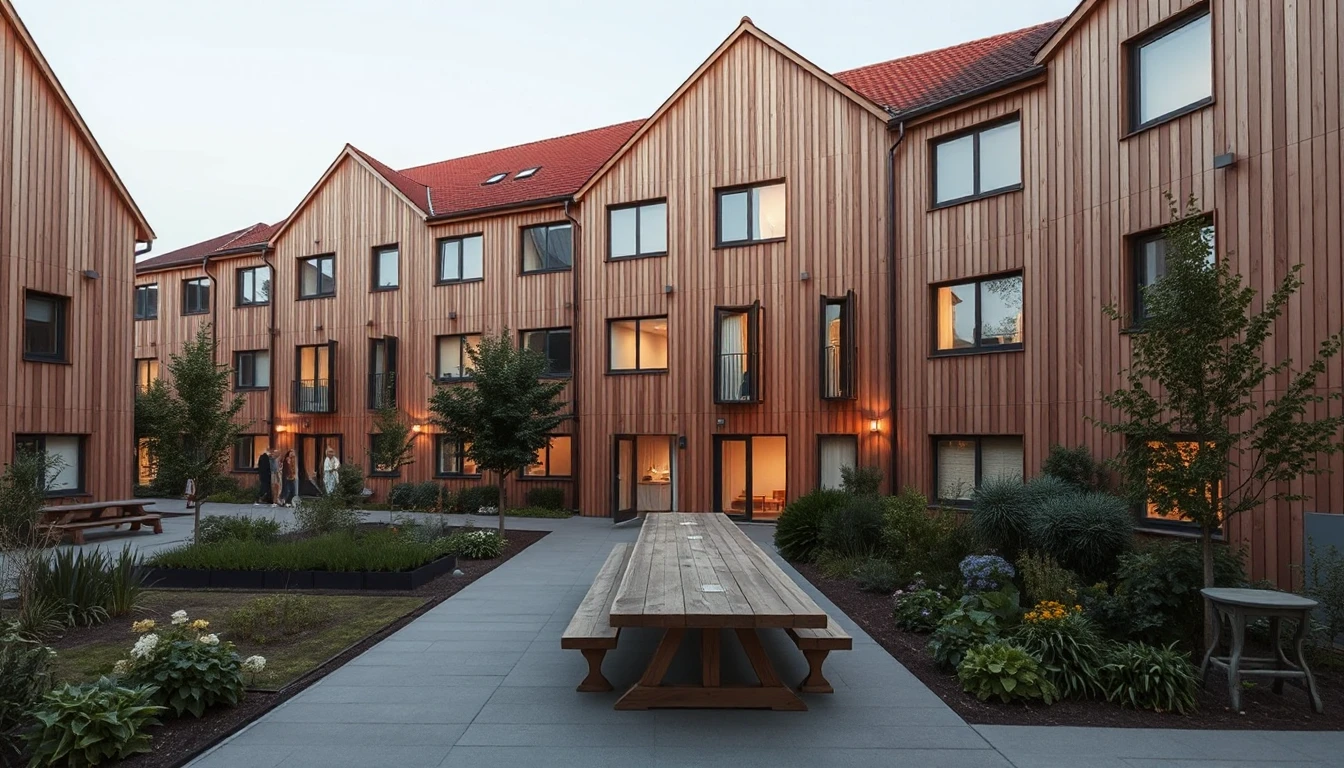
“Living together rather than next to each other” can be a likeable opening line. For a housing decision, however, it still needs to be translated into an ordinary Tuesday. How much community is desired? What work does that create? And how well can one’s own flat actually be used as a place of retreat?
This article develops its own decision aid for communal housing projects in Austria and Germany. It does not assess any particular legal form. Tenancy, ownership, financing and membership documents must be examined separately for the respective project and country.
One promise, two ideas
In our fictional story, Jona is interested in a house project with a communal kitchen. Jona expects occasional shared meals. Two residents understand that to mean a binding cooking rota on several days. Everyone speaks positively about community – but they mean different intrusions into the weekly routine.
This difference is not proof that the project is poorly organised or that Jona does not fit in. It is the most important information before making a commitment. The decision needs a conversation about actual activities, not just agreement with a friendly mission statement.
Consciously get to know three levels
We recommend first considering the flat, the communal rooms and the self-organisation separately.
The flat is about one’s own use: retreat, visitors, working hours and the possibility of closing a door. Anyone who regularly needs quiet need not justify this need only after moving in. The decisive factor is whether the spatial and social practice fits.
Communal rooms can enable many things. But they also require coordination: who reserves, tidies up, provides replacements and decides when wishes coincide? Have an actually typical process shown to you to see how the house deals with it. A room unused for months is not yet proof of a regularly available facility.
For self-organisation ask about recurring tasks, decision-making processes and the real time commitment of those involved. The answer should not be given only by the most active founding person. Different experiences are more likely to show which tasks are required in the background and how bearable they remain when life circumstances change.
Consider a normal day rather than an open-house event
A joint introductory appointment can be helpful if it is agreed for everyone involved. Do not use it as a covert test of the residents. Instead ask for a conversation about an ordinary routine: what happens if someone cannot manage an assigned task at short notice? How is a conflict addressed? Which decision is made in the house and which by an external administration or another responsible body?
Then record your own expectations. Which participation would you like to take on? What can you do regularly, what only occasionally? Where would a binding duty be inappropriate for you? Such boundaries are more valuable than a generous promise that nobody can keep later.
Formulate the housing question to be decided
Supplement the spatial impression with the financial and organisational documents. Voluntary joint activities, actually binding obligations and unclear expectations should be noted separately. Whether an asserted obligation exists legally does not follow from a meeting note alone.
Friendly neighbourhood should also not be planned as already secured personal care. If regular support is essential for your housing decision, it must be clarified explicitly and be viable in your case. The project’s promise does not carry out this clarification.
In the example, Jona does not decide immediately. First it is clarified whether the cooking group is voluntary and which household tasks actually belong to it. Afterwards a concrete question can be answered: “Do I want and can I live here in exactly this form?” An honest no can be as good a result as an informed move-in.