



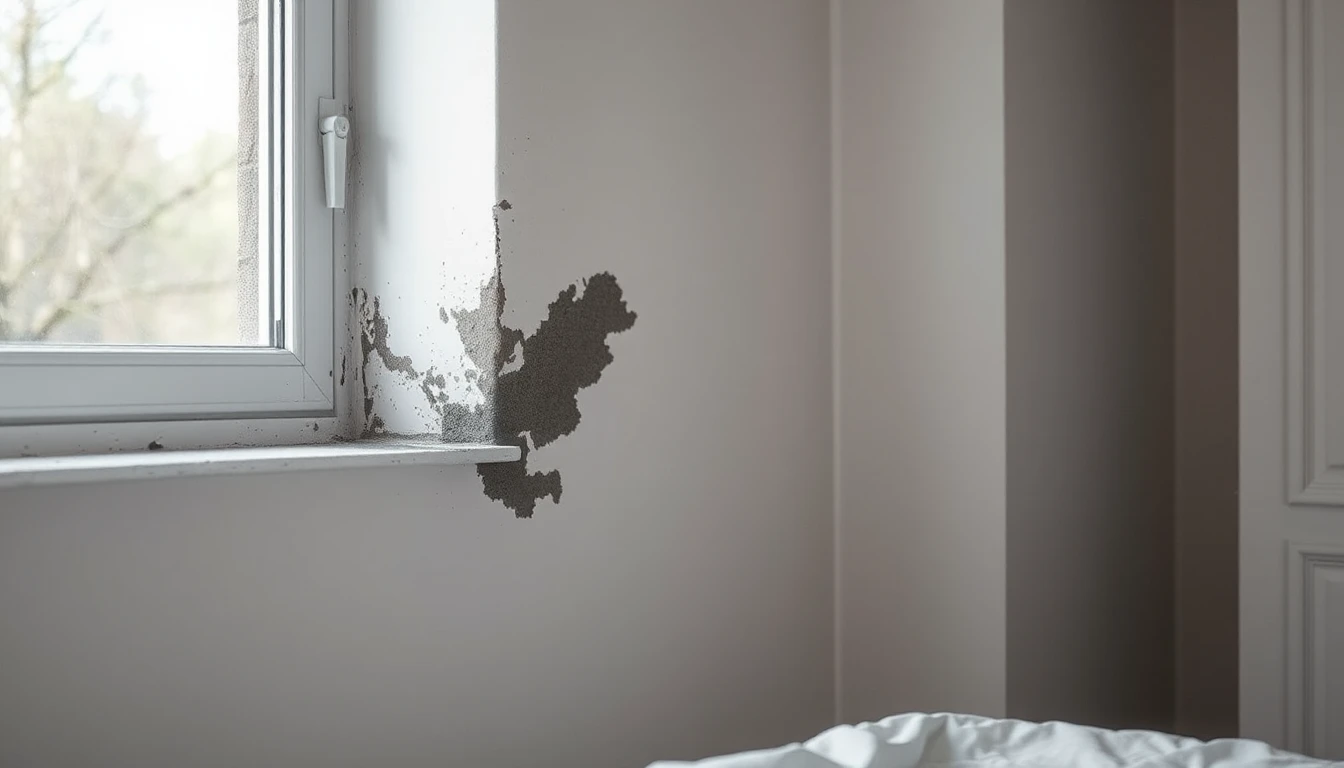
Dark stains in the corner of a room, a musty smell behind the wardrobe: mould is unpleasant and can be harmful to health. Who has to remove it and who pays is decided by its cause. Here you can read how to clarify the cause, what you should inform the landlord about and what rights you have.
The decisive question: Where does the mould come from?
Broadly speaking there are two causes, which often overlap:
- A defect in the building, for example leaking pipes, rising damp, a damaged roof or thermal bridges in the external wall.
- Occupant behaviour, that is insufficient ventilation or heating, lots of moisture from cooking, showering or drying laundry.
Which cause predominates can usually only be assessed by a specialist in building physics in the event of a dispute [S1]. Therefore do not be quick to assign blame, neither one way nor the other.
Who must remove the mould?
Surface growth, building in good order: If the building is intact and the infestation is only on top of the plaster or paint, removing it is part of your maintenance of the flat [S1][S6]. If the infestation is due to insufficient ventilation or heating, the landlord can also hold you liable for the cost of remediation [S1].
Mould in the masonry or posing a health risk: In the full application area of the MRG the landlord must carry out work in your flat where there is a serious defect of the building or a substantial health hazard to be remedied [S2]. Mould that has penetrated deep into the masonry and cannot be removed with a surface treatment is regarded by the Arbeiterkammer as a serious defect of the building [S1]; heavy infestation can also constitute a substantial health hazard [S3].
Other flats: In the partial application area and with full exceptions from the MRG the ABGB applies. According to this the landlord must basically keep the flat in a usable condition [S4]. However, this duty can be contractually regulated otherwise [S5]. It is therefore particularly worth taking a look at your tenancy agreement.
Inform the landlord and secure evidence
Report the mould as soon as possible and in writing. You must notify the landlord without delay of serious defects of the building in the full application area, otherwise you can be liable for consequential damages [S6]; the ABGB contains a similar duty for all tenancies [S7]. It is sensible to state at the same time that you will henceforth pay the rent only under protest; this is also recommended by the Arbeiterkammer [S1].
Own tips for securing evidence:
- Photograph the affected areas with the date, ideally with a scale next to them, and repeat this at regular intervals.
- Measure room temperature and humidity with a simple hygrometer and note the values.
- Record how and when you ventilate and heat.
- Keep correspondence and medical findings if health complaints occur.
This will help you later if an expert report is to clarify the cause.
Your rights in the case of mould
Demand repairs: If the landlord is responsible and does not react, you can apply in the full application area for the necessary maintenance work to be ordered [S8]. In municipalities with a conciliation body, for example in Vienna, you must first go there; elsewhere the district court is responsible [S9][S3].
Rent reduction: If the flat is only partially usable because of the mould without your fault, you are relieved of the rent for the duration and to the extent of the impairment [S4][S1]. How much the reduction is depends on the individual case. Do not reduce the rent unilaterally, but pay under protest and seek advice.
Early termination: The ABGB allows you to terminate the contract without notice if the flat becomes unfit for the agreed use without your fault. For flats that are harmful to health this applies even if you contractually waived this or knew the condition when moving in [S10]. Whether a particular mould infestation makes the flat harmful to health in this sense is a question of the individual case and usually can only be answered with expert assessment. Before taking this step, be sure to get advice from the Arbeiterkammer, a tenants' organisation or a lawyer.
Fictional example: In an old building flat in the full application area a patch develops behind the bed that returns a few days after washing. The tenant reports it in writing, pays under protest and documents her ventilation. An expert report shows a damp external wall. That suggests a serious defect of the building which the landlord must deal with [S1][S2], and a reclaiming of rent for the period of impairment comes into consideration [S4].
Preventing it in everyday life: ventilate and heat
The following points are own tips and not legal requirements:
- Ventilate several times daily for a few minutes with windows wide open, instead of leaving windows tilted open permanently.
- Do not let rooms cool down significantly when absent.
- Ventilate immediately after showering, cooking and drying laundry.
- Place large pieces of furniture a few centimetres away from the external wall.
- Keep an eye on the humidity; persistently very high values are a warning sign.
If you live like this and the mould still returns, this speaks more for a structural cause. In that case the landlord is the right contact.