



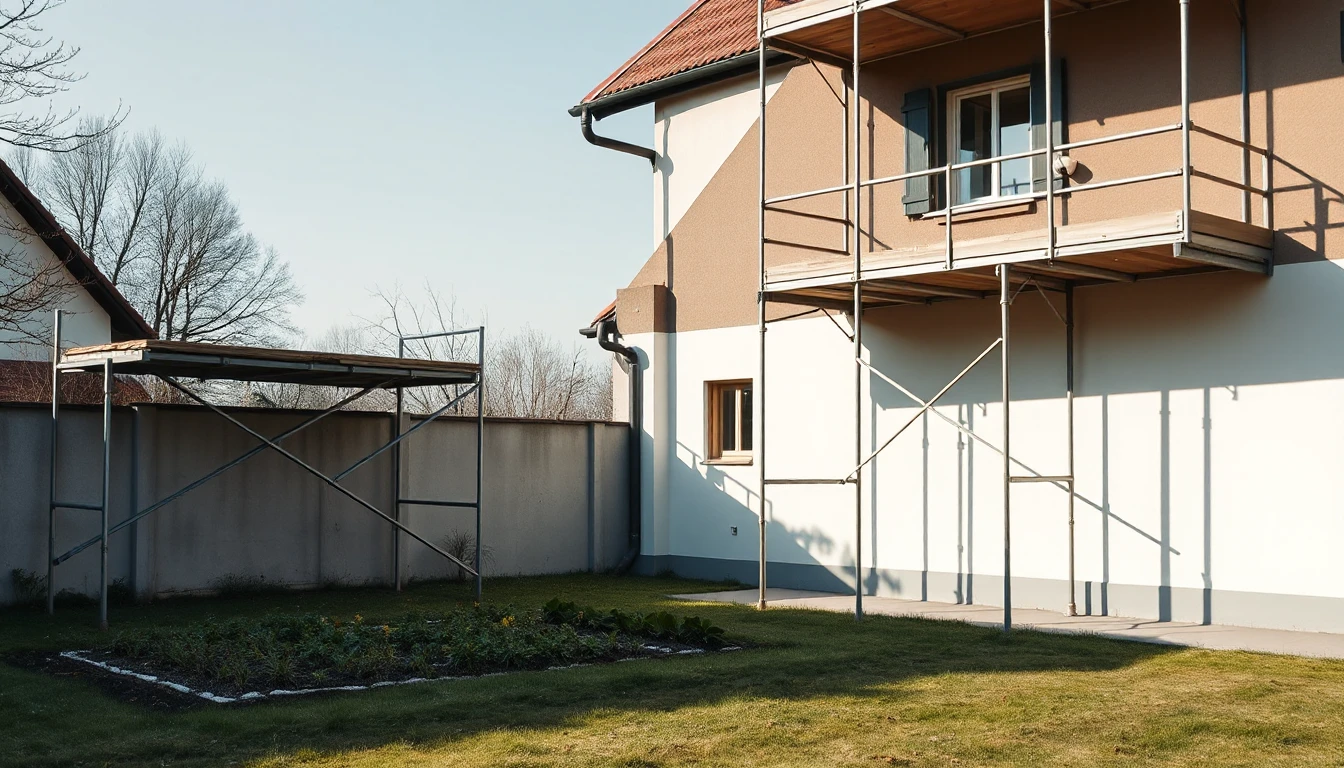
For the planned work on your own house, scaffolding is to be placed on a neighbouring area. This concerns not only the execution dates. Before you commit to a fixed start, the area required, the duration and the legal route for the use should be described clearly. For Lower Austria there is a special framework for this in the building regulations.
A limited tolerance is not general access
§ 7 NÖ BO 2014 covers the temporary use of neighbouring plots, structures and their airspace for certain construction and maintenance tasks. The prerequisite is that these can only be carried out in this way or otherwise only with disproportionately high costs. For the regular use paragraph 1 generally provides for at least two weeks' prior notification; special constellations and imminent danger are regulated separately. [NACHBAR]
The rule must therefore not be reduced to "you may always enter the neighbour's property for building work". A non-binding idea for execution is likewise not yet a confirmed authorisation for any desired erection.
Paragraph 5 requires a joint determination of the existing condition before the covered works and thereafter a corresponding reinstatement condition. If refused, paragraph 6 provides for an administrative decision process on necessity, scope and duration. [NACHBAR] No instructions for unilaterally enforcing access are derived from this here.
Derive the area from the actual way of working
Please ask the specialist planner or executing company for a clear presentation of the requirement. Where would the scaffold stand, which access would be necessary and for what period? Distinguish the pure set-up area, required pathways and additional storage requests.
A tight working requirement and a material space convenient for the operation are not automatically the same task. The alternatives and their actual effects should be technically comprehensible. You do not have to decide a statutory proportionality test yourself, but you should be able to explain the execution assumed.
Take the affected everyday life seriously
Our editorial recommendation is also to make the use of the neighbouring area visible. Is an access affected, must an item stand elsewhere temporarily or are certain times particularly important? Such information helps in a practically implementable coordination, without privately redefining the legal claim or its limits.
Record agreements and open points in a comprehensible way. A discussion that proceeds amicably does not replace the clarification of whether the exact scope later installed is covered by it. Changes to the period or execution should therefore be coordinated again.
Link initial condition and completion
In the fictitious example, scaffolding for façade work is to stand next to a paved neighbour access. The first scheduling contains only start and end. In the concrete presentation it becomes apparent that a frequently used path would also be affected temporarily.
The parties have the work requirement and possible design clarified. Before commencement the relevant condition is recorded jointly; on completion the reinstatement is tied to this. If no agreement on the use can be reached, the intended legal route is clarified before a company simply creates facts.
This article concerns Lower Austria. It does not confirm a concrete tolerance entitlement and does not replace an official or legal assessment. The prepared result should be a clearly described, time-limited task in which access, evidence preservation and reinstatement are considered together.