



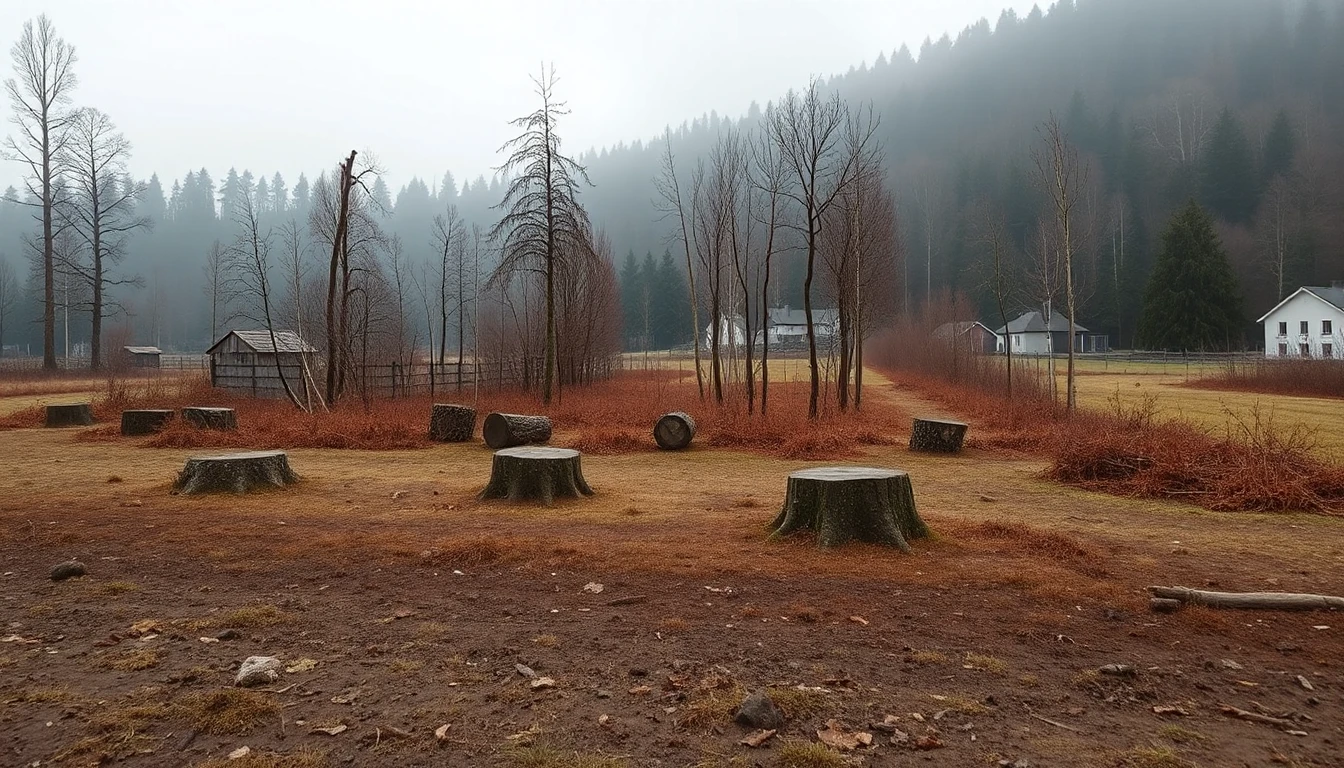
You want to use part of a forest property for a different purpose. Perhaps it concerns a space, an access or a facility that has nothing to do with the previous forest management. In Austrian forestry law it is not solely decisive whether trees are felled. The use actually intended for the area must be clarified before implementation.
Dissociate the concept from mere tree removal
§ 17 paragraph 1 Forstgesetz 1975 describes the use of forest soil for purposes other than those of forest cultivation as clearance (Rodung) and contains the fundamental prohibition in this regard. Further paragraphs regulate administrative approval possibilities and the balancing of interests. [WALD] The legal subject is therefore broader than the everyday image of a felled tree.
For that reason describe your intended use completely. “Hardly anything will be changed” does not replace information about what is to happen on which area. If there is uncertainty, have the actual forestry-law classification of the area clarified by the competent authority or suitable specialists. A private property description is not a final decision for that purpose.
Small areas are not automatically free
§ 17a provides, under certain conditions, for a notifiable clearance without a clearance permit. These include, among other things, at most 1.000 square metres, a notification by the person entitled to apply with the required documents and the absence of the more detailed official communication within six weeks. The provision contains further rules on adjacent previous clearances, validity and temporary clearance. [ANMELDUNG]
Do not shorten that to “Under 1.000 square metres I may simply start”. Have the complete prerequisites for the specific project checked. This article does not calculate an area, does not confirm a notification and does not assess either the expiry of a deadline or an individual entitlement.
Submit the intended use with the correct reference to the property
Prepare a comprehensible presentation of the affected area and its surroundings. Note which interventions or facilities are planned and whether the use is intended to be permanent or temporary. Mark draft variants as such.
Ask which further bases are required for the assessment. A forestry-law clarification is not automatically the complete permission for every structural or other measure. Other relevant requirements must also be examined separately in a manner appropriate to the location and project. This article does not replace specialist planning or approval.
A small area with a different purpose
In the fictional example an owner wishes to prepare a forest area regularly for a private other use. He initially assumes that without major tree felling no forestry-law question could arise.
Before commissioning he describes the actual use and has it classified. The size is examined together with the further prerequisites, not treated as sole clearance. A possible formal procedure is then pursued further with the correct subject matter. The example does not state that this exact use could be approved.
Keep the reviewed status until execution
Record which area and variant were actually the subject of the information or decision. If purpose, extent or duration change, the appropriate further examination will be clarified. A response to the original idea will not be tacitly transferred to an extended project.
The result of the preparation should be unambiguous: what is intended, which basis is actually in place and which step is still open? That way a seemingly harmless intervention does not become a commenced project whose legal subject of use can only be recognised afterwards.