



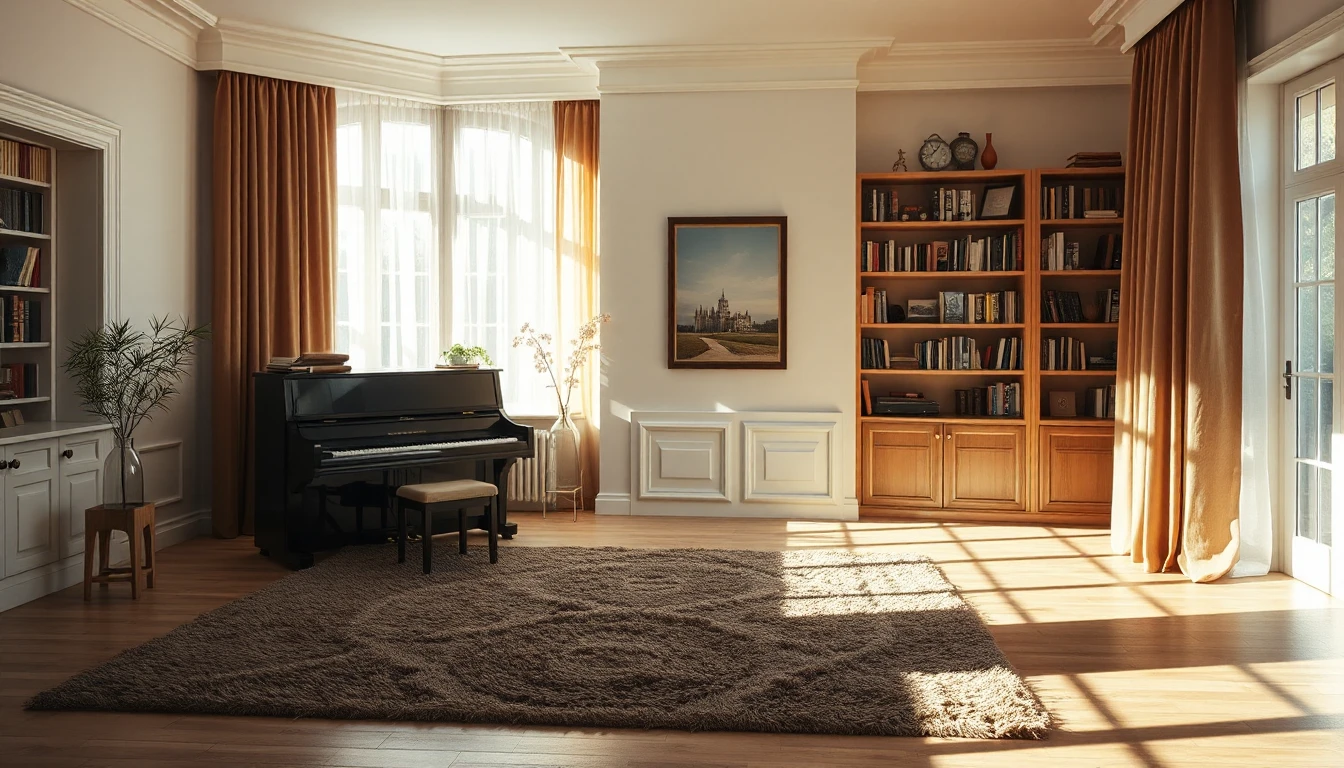
You want to play the piano, violin or another instrument regularly and are looking for a new flat. Then the question of whether your instrument fits into the living room is not enough. You need a realistic plan for when, where and in what way making music can take place in your everyday life. The following steps are editorial recommendations for flat hunting in Austria and Germany. They do not determine permitted practice times and do not assess structural soundproofing.
Describe your own needs without rationalising them
First write down what you actually intend to do: which instrument, alone or with others, on which weekdays and at what actual times of day. Distinguish occasional private playing from lessons, rehearsals with several people or professional use. You should not hide these activities under a single vague statement.
Also record preparation and storage. An instrument case requires a different place than a permanently set-up drum kit. Sheet music, stands, accessories and a free movement area are also part of the requirement. Your own wishful thinking that you could practise much earlier every day in future should only be taken into account once your other daily routine actually allows it.
Set three tasks for the floor plan
For each listing, check the practice space, the storage and the other use of the room separately. A room can be large enough and still be needed daily for several incompatible tasks. For this reason, draw the intended set-up in a separate simple room plan. Mark which dimensions are known and which you will want to remeasure at an authorised viewing appointment.
Also consider who at home wants to work, sleep or withdraw while you are playing. A practice spot in a thoroughfare room is a different decision to a room that can be reached separately. However, from the layout of the rooms alone you cannot reliably infer how strongly other people will later perceive the sound. Treat a conjecture about adjoining rooms not as a confirmed structural feature.
Use the viewing to ask concrete questions
Ask what information is available about the building and existing rules of use and what use the offered flat is actually intended to enable. Formulate your requirement in an understandable way, instead of demanding a blanket assurance that there will never be complaints. If commercial or other special use is envisaged, its permissibility should be clarified separately.
A short silent viewing is not a reliable proof for all later acoustic situations. An existing carpet, a closed door or the statement that the house is quiet also do not replace a professional soundproofing assessment. Do not try the instrument without asking and do not publish any recording from other people’s living spaces. If a personal trial is agreed, also document its conditions for yourself; it remains a limited snapshot.
Plan a viable alternative
Before making a commitment, consider which activities absolutely must take place at home and which could be done elsewhere. This may include searching for an actually available practice room, a community-organised rehearsal or a different scheduling arrangement. Only include confirmed offers. A theoretically nearby room will not help you if it is not bookable at your times.
Compare the overall burden: housing costs, additional room usage, travel, transport of the instrument and organisational effort. An apparently suitable flat can thus become less practical than another flat with a reliable external practice option. Do not decide solely on the basis of a nicely furnished potential music room.
Example: The spare room already has two other functions
In the fictional case, one person plays the violin in the evening. The second room of the offered flat is also intended to be the partner’s study and a guest room. When going through the weekly times together, it becomes apparent that all three uses require the same period. Instead of resolving the conflict only after moving in, the couple consider a different room allocation and an external rehearsal option. As long as both remain open, the room is not assessed as a secured practice place.
Decide with a clear open question
At the end, for each flat bring together what fits spatially, what is organisationally compatible and what still needs to be clarified professionally or contractually. A suitable flat does not have to offer every desired solution. However, it should not appear suitable only because you omit the most important part of your everyday life from the assessment. General statutory practice times or guaranteed measures against complaints cannot be derived from this practical search method.