



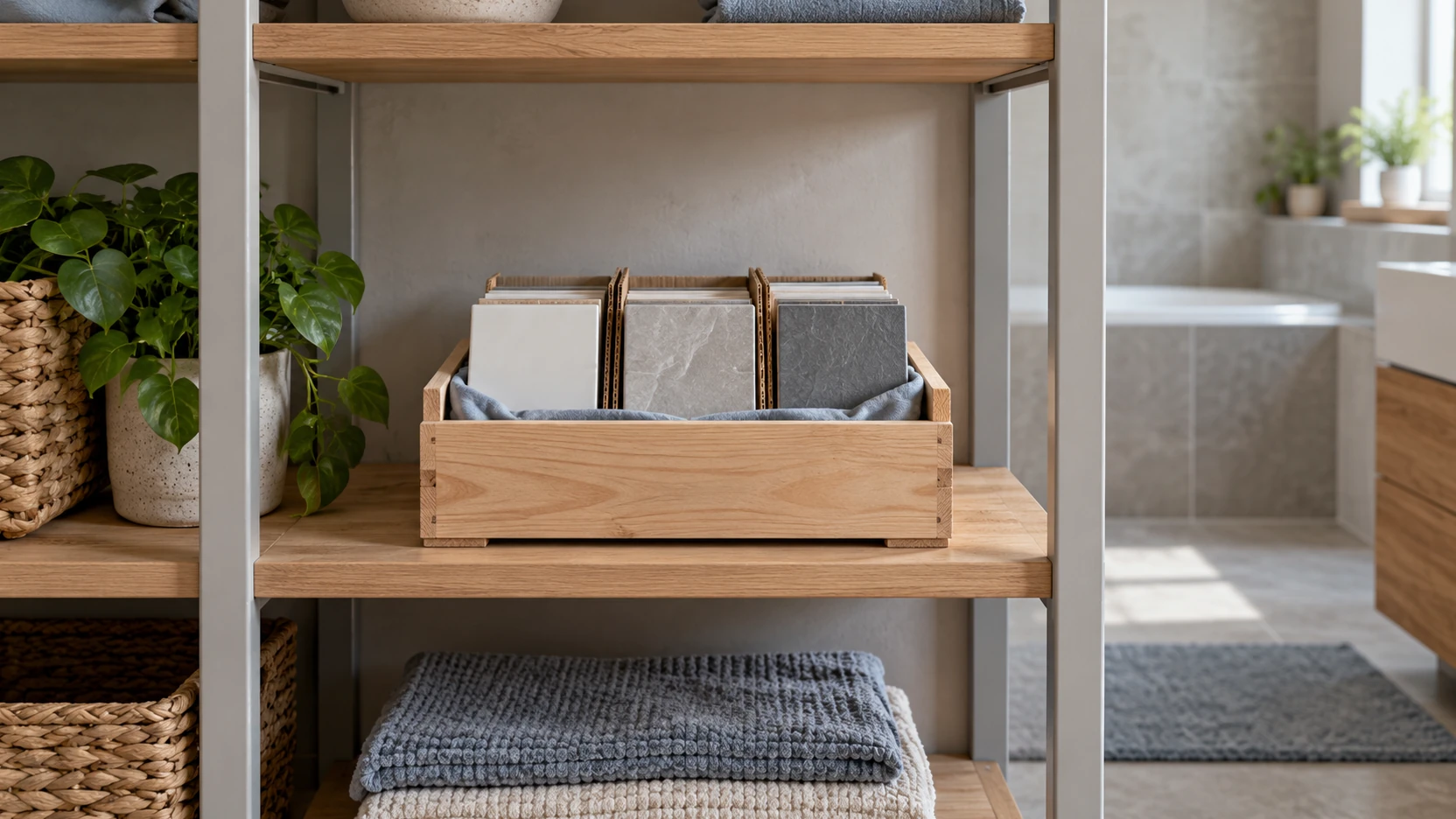
The renovation is almost finished and in the adjoining room there are still boxes, samples and individual leftover pieces. Keeping everything would take up space; giving everything away can make later enquiries unnecessarily difficult. A small repair reserve should therefore be compiled purposefully together with the contractor. This recommendation describes organisation and does not establish storage or shelf-life rules.
Name the possible later use first
Ask the contractor for which later small jobs a reserve might be useful and which materials are suitable for that purpose at all. Avoid a blanket instruction to stack all leftovers somewhere. An identifiable replacement piece for a specific area has a different usefulness than a box of unknown offcuts.
In the fictional example, several tile variants were used in an apartment. In the end there are some clean pieces and various opened processing products left over. The owners choose the suitable reserve tiles with the contractor and assign them to the rooms. For the remaining products they ask whether and how they may still be intended to be used or stored. The decision is not derived from the mere remaining quantity.
Take product information and leftover material together
Record the exact designation and, where available, the associated variant or batch information. Note where the material was installed. A room photo can help to understand the assignment later. Use only your own or permitted pictures; another person’s product photo does not replace the clear designation.
Please also ask for the information useful for a later professional enquiry. This can include who carried out the original work and which documentation belongs to the chosen execution. This short linkage is more helpful than an uncommented collection of similar catalogue sheets.
Adapt the reserve to the available space
Decide only afterwards what you actually want to take over. Ask for the concrete manufacturer instructions and have the contractor explain any necessary conditions. This text neither recommends storing opened chemicals in the living area nor making your own assessment of their continued usability. Appropriate storage or disposal is also not determined solely from the product name.
Label the taken-over reserve clearly and file the assignment where you will later look for it. If another person looks after the apartment, they should be able to understand what the stored pieces are intended for. A few clear details are sufficient for this; an extensive new house file is not necessary.
Do not promise a later repair to be invisible in advance
The reserve prepares for a later enquiry. It does not guarantee that a repair is possible or will be visually indistinguishable. If a spot is affected at some point, the specialist contractor should assess the actual condition and the possibilities. A suitable leftover piece does not constitute an approval to execute.
The sensible final result is: selected reserve, unambiguous product reference and an understandable intended use. The procedure is an editorial recommendation for Austria and Germany. Rights, warranty, required quantities and material properties are not determined by this.