



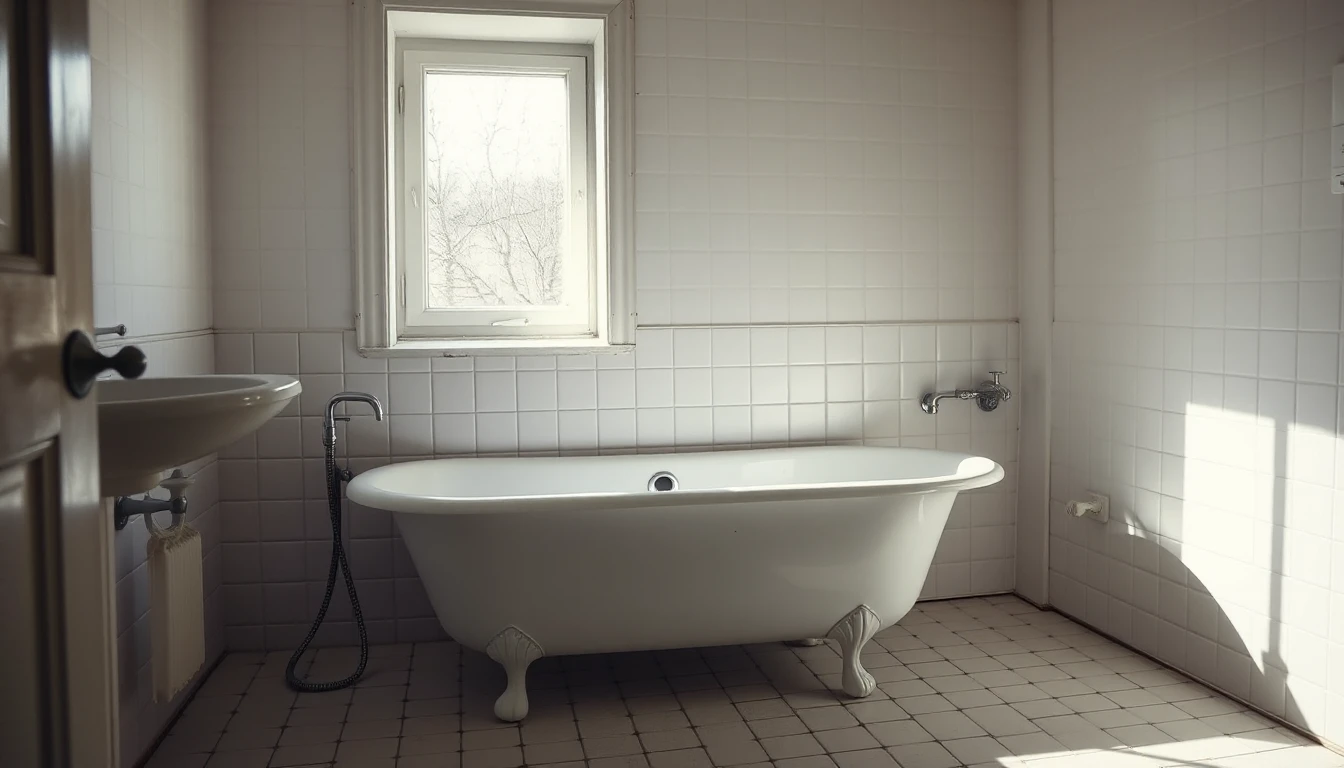
Whether the WC is inside the flat or in the corridor and whether there is a proper bathroom are not minor matters under Austrian tenancy law. The equipment category determines, within the full application scope of the Mietrechtsgesetz (MRG), whether a fixed maximum amount applies to your flat or whether the guideline rent (Richtwert) applies with reductions. Here you will learn how the classification works and which point in time is decisive.
The four categories at a glance
The MRG classifies flats according to their equipment into four categories [S1]:
- Category A: usable condition, at least 30 m² usable floor area, room(s), kitchen or kitchenette, antechamber, WC and a contemporary bathing facility (bathroom or bathing niche), plus a communal heating supply, floor heating or equivalent permanently installed heating as well as hot water provision.
- Category B: usable condition, room(s), kitchen or kitchenette, antechamber, WC and contemporary bathing facility – heating, hot water and minimum size are not required.
- Category C: usable condition, a water outlet and a WC inside the flat.
- Category D: no water outlet or no WC inside, or one of these two facilities is not usable.
“Inside” means: you can reach the WC and water without leaving the locked flat. A WC in the corridor is not sufficient [S5].
Which point in time counts – and what applies in case of defects
The decisive factor is the state of equipment at conclusion of the tenancy agreement [S1]. What you later install yourself or what the landlord later upgrades generally does not change the classification of your existing contract.
There is an important rule for defects at the start of the contract: if the flat or an equipment feature was not usable at that time, or the bathroom did not meet the contemporary standard, this will only be taken into account for the classification if you have reported it to the landlord and they did not remedy the defect within a reasonable period – at the latest within three months from receipt of your report [S1]. Therefore make this report in writing and keep evidence of it.
If a single feature is missing, it can in some circumstances be offset by features of a higher category. However, a missing bathroom cannot be compensated in this way [S1].
What “usable” means
The law does not itself define “usable”; the case law focuses on whether the flat is suitable for immediate habitation. Defects that impede use but can be remedied at any time without major expense do not contradict usability [S2]. It can be different with dangerous installations, for example with electrical, gas or water installations that cannot be brought into a compliant condition without substantial work [S2][S5].
Hypothetical example: At the handover two socket covers and a window handle are missing. That is annoying but does not make the flat unusable. If, by contrast, the entire electrics lack a protective conductor and can only be made safe by extensive work, the classification may be different – the decisive factor is the concrete individual case.
Category rent: fixed limits for Category D
For flats of Category D the full application scope provides – unless an exceptional case for a reasonable rent applies – a fixed maximum amount per m² usable floor area and month [S3]. The amounts are regularly adjusted. From 1 April 2026 they are [S4]:
- Category D, not usable: €1,13
- Category D, usable: €2,25
Until 31 March 2026 the values were €1,12 and €2,23 [S4]. On 1 April 2027 they may increase by at most two per cent [S3]. If your contract is time-limited, the category rent is also reduced by 25 per cent [S3].
Hypothetical example: A 45 m² flat with water in the kitchen but WC in the corridor, in usable condition, let on an unlimited basis in June 2026. The maximum permissible is 45 × €2,25 = €101,25 main rent per month; for a time-limited contract it would be €75,94. Operating costs and VAT are added.
And categories A to C?
The law sets so-called category amounts for all four categories, which from 1 April 2026 are: A €4,51, B €3,38, C €2,25 and D €1,13 per m² [S1][S4]. For newly concluded contracts for flats of Categories A, B and C, however, they are not a rent ceiling. There the guideline rent (Richtwertmietzins) applies – unless an exceptional case for a reasonable rent applies – and for Category B or C a reduction from the guideline is to be made compared with the standard flat [S3].
It can be different for older contracts: for main tenancy agreements from the period 1 January 1982 to 28 February 1994 the category amounts were the decisive maximum [S6]. Special transitional and increase rules also apply to such old contracts [S7]. Have such a contract checked by a tenant advisory service or the Arbeiterkammer if in doubt – also if you suspect your flat was classified too high at the time the contract was concluded.