



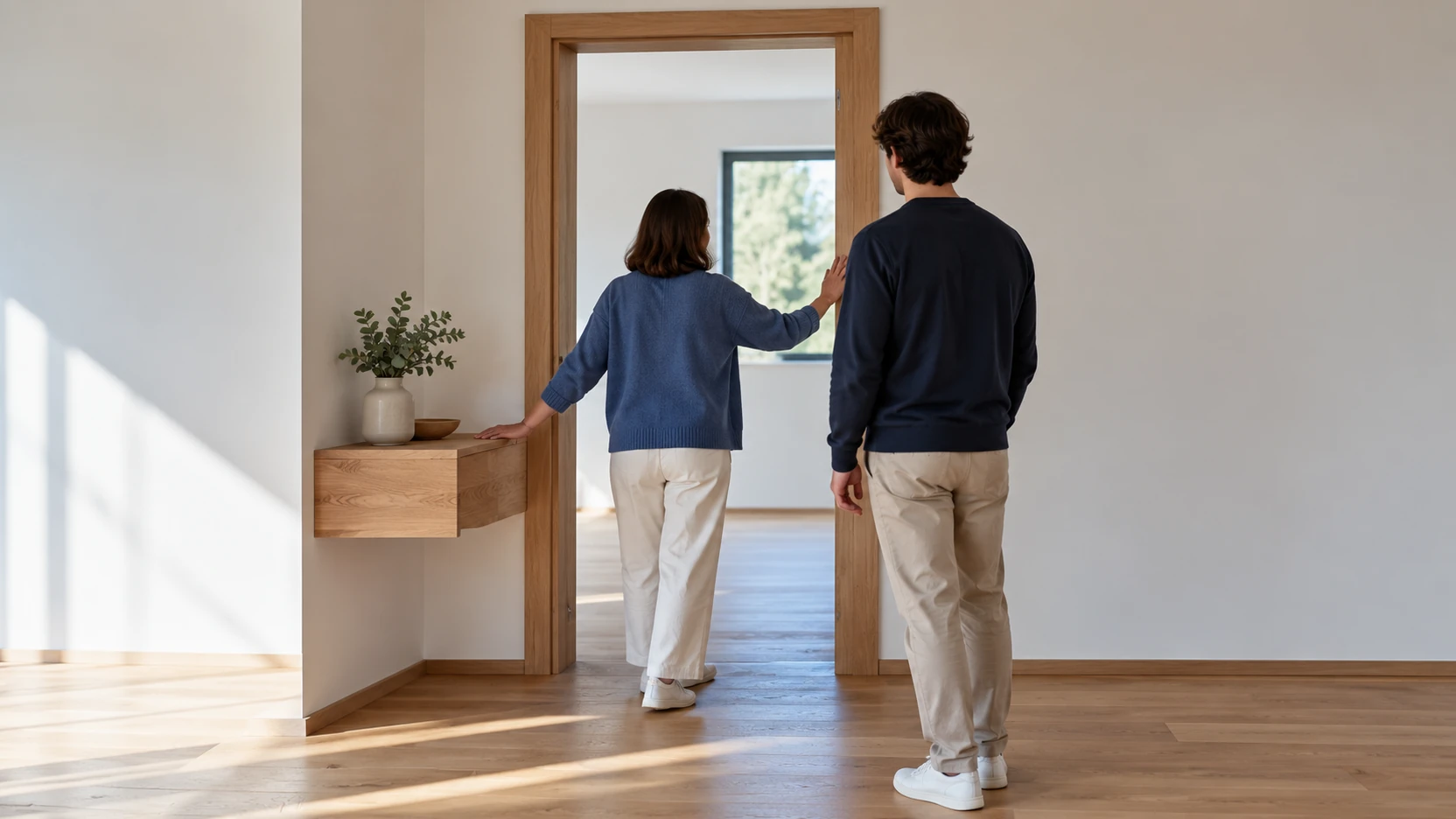
If photos and quick visual impressions say little for your housing decision, the viewing needs a different preparation. With a visual impairment, your personal habits, aids and preferred routines determine what you actually want to check. This article offers practical recommendations for Austria and Germany. It does not establish medical requirements, structural standard dimensions or an entitlement to specific assistance services.
Describe your own use before the invitation
Start with the actions that are important to you in your current flat. How do you find your way from the entrance to the kitchen, bathroom and private room? Which orientation is helpful for you, which situation is uncomfortable? What do you want to try yourself and where would you like concrete assistance? There is no single profile that fits all visually impaired people.
Our recommendation is to formulate a few clear requests for the appointment from this. Perhaps you need a calm description of the floor plan, sufficient time or the possibility to walk a familiar everyday route. Share only the information necessary for the desired preparation. A full medical report does not automatically belong in an ordinary viewing request.
Ask for an information format that you can use. A plan can be described in another form; information sent solely as a photo is not equally usable for every person. Clarify concretely what can actually be provided before the appointment. This article does not promise any specific format of a portal or provider.
The route does not end at the flat door
Include the actual route from the means of transport or pick-up point to the entrance. Ask in advance for the correct address and meeting point. A companion can assist if you wish; you determine the tasks and desired pace yourself.
At the appointment, take only safe, agreed routes. You do not have to try an unfamiliar staircase or other unsafe situation just to tick off a check point. Where you do not want to test something yourself, note the remaining question and a suitable next clarification. Personal orientation is not understood here as a technical safety clearance.
Describe the chain of ways with your own reference: finding the entrance, getting to the correct floor and recognising the flat door. Whether an existing system works for you results from the concrete use, not from the mere mention of lift or intercom in the listing.
Get to know the rooms through a few activities
Choose typical routines: arriving and putting something down, preparing a drink, storing clothing or reaching the bathroom and sleeping area. Have the current condition explained first and then decide what you want to look at, feel or check in another way that suits you. In doing so, the belongings and personal areas of other residents remain respected.
An empty room and its later furnishing are different situations. Consider what of your own furniture you want to bring in and which routes that will create. Separate a property that actually exists from a merely imagined future adaptation. If a change is decisive, first clarify its concrete execution, permission and costs with the responsible authorities.
You do not have to create a complete adaptation plan from this viewing. The goal is a housing decision with recognisable personal requirements and open questions. Appropriate individual advice can be added for structural or technical suitability.
Support must not take over the decision
If someone accompanies you, agree in advance on limited tasks, such as taking notes or providing additional description. The other person can supplement their observation, but should not present it as your own perception. A nice view may be important to them, while the routes and accessibility matter more to you.
After the appointment, first note or dictate your own impressions. Then add the information provided by the offering side and the companion’s observations as distinct types of information. This creates a decision sheet readable or audible for you, rather than a stranger’s judgement about your future flat.
A fictional comparison
A person compares two flats. For the first offer they find the internal route easy to follow, but there is not yet suitable orientation at the building entrance. The second seems less spacious in the photo; however, the actual access and their preferred room sequence fit better. The companion initially prefers the first offer.
Both views remain recognisably separate. The person searching clarifies the open entrance area afterwards and decides themself on another appointment or a rejection. There is no blanket winner and no claimed disability-friendly certification. The progress lies in the comparison being based on their actual use and necessary support enabling their own decision.