



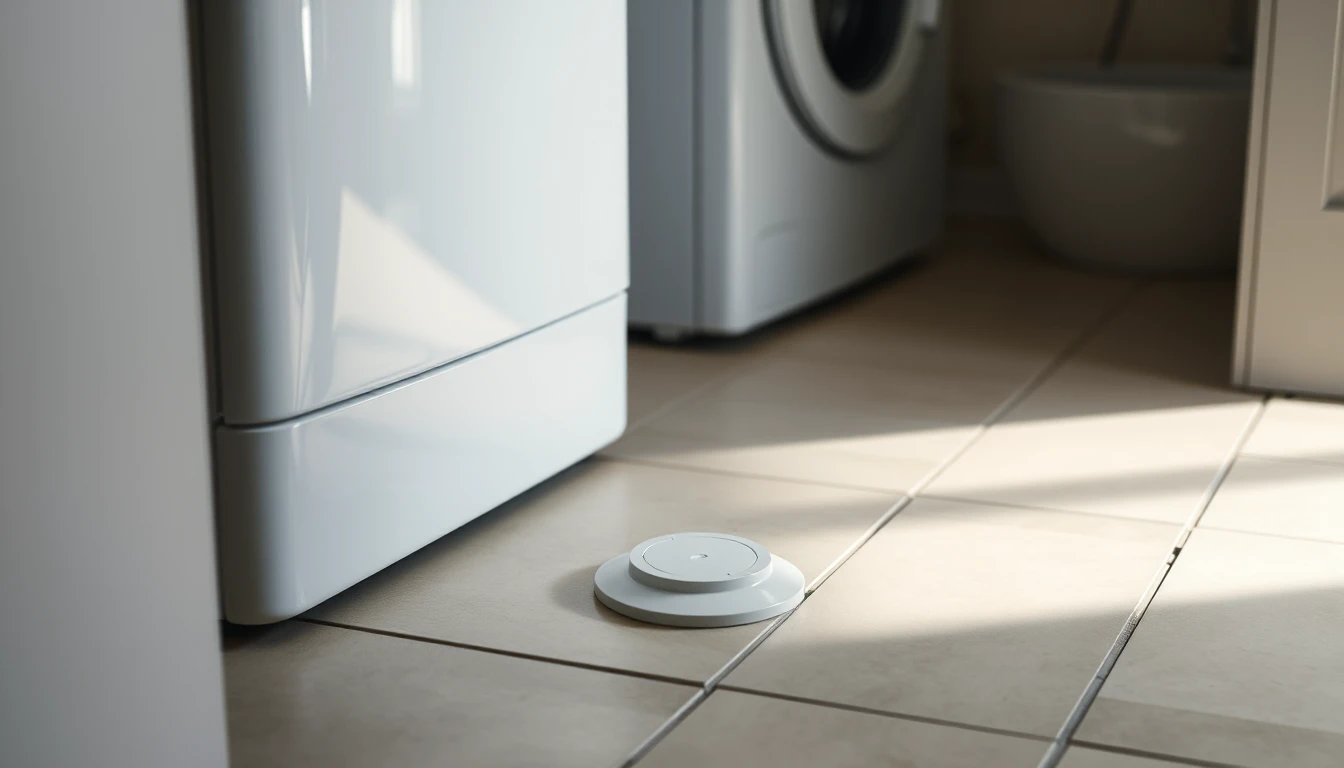
A water sensor is recommended for the utility room. Your primary aim is to prevent an unnoticed water escape from running for a long time while you are away. Before purchase it must therefore be clear which response you expect: a warning message or an additionally provided automatic shut-off.
Read the concrete function instead of the collective name
A published GROHE user manual distinguishes a sensor that detects and warns of water accumulation from a water control device built into the pipework with a possible shut-off function. It also describes the interaction of both devices. [WASSER] The example shows different tasks; the 2020 edition is not used here as a current product or availability recommendation.
Our editorial recommendation: For every current offering have it explicitly stated what the specific product included actually does itself and what additional equipment would be necessary. A suitable app view is not proof that an automatic shut-off would actually be present in your own home.
Limit the desired scope of protection spatially
Describe at which known locations a warning is wanted and which water supply should possibly be professionally included. Ask about the situations that are detected and the cases that are explicitly not detected. A sensor in one place must not be presented as general monitoring of every concealed component in the house.
If a shut-off function is being considered, have the suitability for the existing installation checked. The decision requires a professionally described scope and appropriate operating conditions. This article does not contain installation instructions, changes to shut-off devices or self-selected trigger thresholds.
A warning needs a reachable response
Consider who will receive a notification and subsequently be able to reliably organise help. Clarify the actual dependencies of the offered system, such as power, connectivity, batteries and required notification settings. These are questions to check, not guaranteed properties of every product.
An automatic function also needs understandable information about faults, feedback and further care. Ask how a displayed condition should be classified and which actions are reserved for professionals. For a demonstration the household should not create a leak or flood a room.
Hypothetical case: the push notification alone does not satisfy the desire
An owner who is frequently away wants the water supply to be automatically limited for certain detected problems. The first offer contains only a notifying sensor. He clarifies the difference and has it checked whether an additional professionally suitable solution is possible for his house. A purely warning device can still be useful; however it must fit the consciously chosen goal.
Record the confirmed function and its limits with the product allocation. None of the options described here guarantee complete freedom from damage or replace necessary maintenance of systems. The purchase decision becomes usable when the detected situation, the intended response and the responsible care coherently fit together and can be followed.