



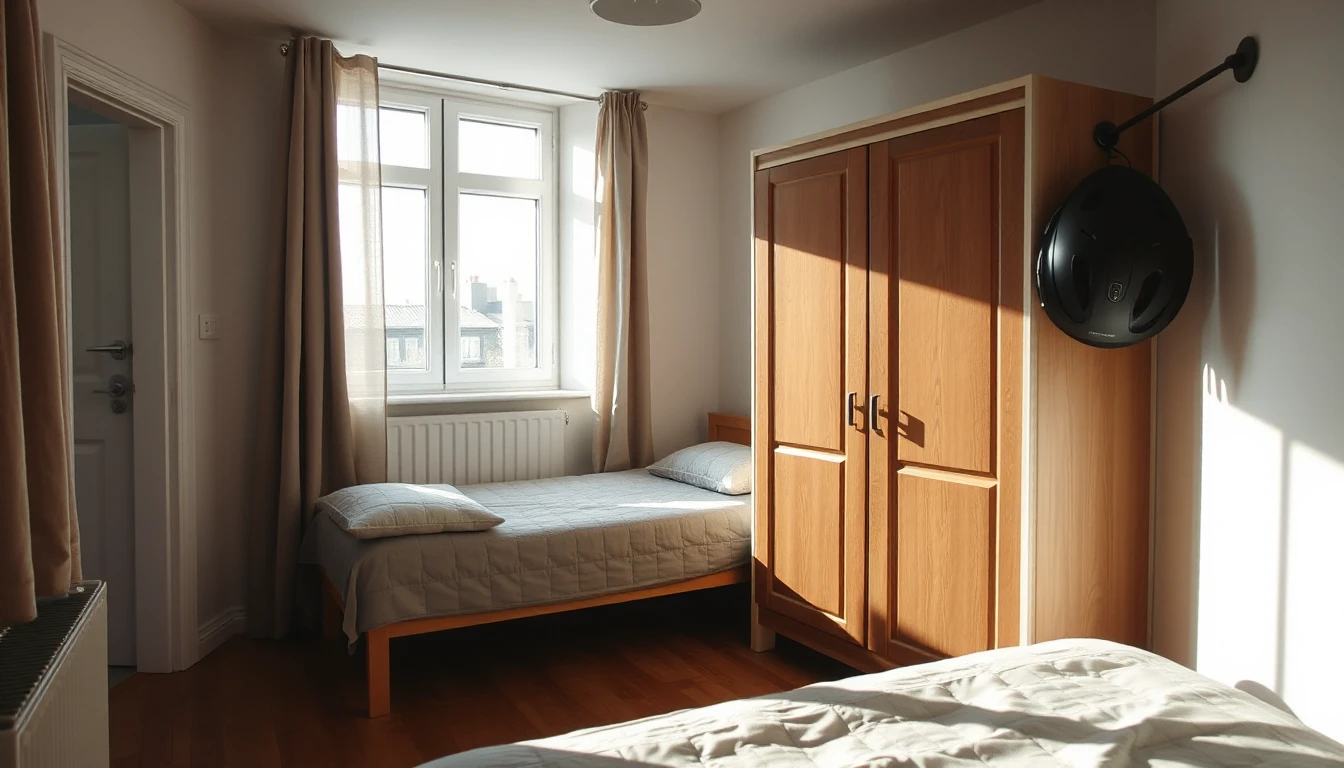
One room is available, bed and wardrobe are already in it. You want to rent it out and continue living in your flat. For Germany this constellation can have special rules. However, it does not arise automatically with every furnished offer. Before giving your consent you should examine the living situation, the agreed furnishings and the intended resident household together.
Your own flat is the starting point
§ 549 Absatz 2 Nummer 2 BGB concerns residential space as part of the flat actually inhabited by the person renting it out. A separately let flat in the same building is therefore not already the same case. Mere ownership of the flat does not replace actual self-occupation. [RAHMEN]
Our practical recommendation: First describe the spatial situation. Which room is being left solely to the tenant, which areas are shared and where do you yourself live? Use a comprehensible plan for that. The chosen headline “WG” or “furnished living” should not obscure the actual form of living.
Furnishings and household belong to the classification
The provision also requires that the person letting the room predominantly equip it with furnishings. In addition it contains an important limit: the exception does not apply in the described form if the room is handed over for permanent use with family or with persons of a long-term shared household. [RAHMEN]
Therefore check not only how many pieces of furniture are visible in the photo. Which furnishings are contractually owed and who is intended to live there and how? A blanket query about personal family planning is not a sensible preparation for this. It is about the actually offered and agreed use of the specific room. Cases of doubt are professionally classified before special termination rules are planned.
What the special case changes for termination
For the cases mentioned in § 549 Absatz 2 certain protective provisions are excluded, among others § 573 BGB. However, this does not result in a contract free of law without further duties. The concrete agreement and the rules that continue to apply remain important. [RAHMEN]
§ 573c Absatz 3 provides for termination in the very case of § 549 Absatz 2 Nummer 2 at the latest on the 15th of a month to the end of that same month. That is not a general rule for all furnished flats. The written form of termination under § 568 Absatz 1 remains to be observed. A note of a conversation about a possible move-out is therefore not automatically the required termination. [FRIST] [FORM]
Two enquiries for the same room
In the fictional case Tobias lives in his flat on a permanent basis and offers a room that he will furnish. One person wants to move in alone. Another enquiry concerns two people who want to run their joint permanent household there. Tobias does not treat the two uses unexamined as the same statutory special case.
He has the requirements assessed in each case on the basis of the actual offer. The example does not say that an enquiry must be accepted or rejected. It shows why an earlier classification for a person living alone does not automatically cover every later resident constellation. A changed form of living during the contract period should also not merely be entered in a contact list.
Still agree the shared everyday life in full
Our editorial recommendation: Discuss everyday use just as carefully as the legal framework. Kitchen, bathroom, storage and access must work in practice. Record the included furnishings and their condition in a comprehensible way. This is about the actual performance, not a list of arbitrary household wishes which are then presented as implicitly binding.
Remuneration, agreed services and any security also need a clear contractual status. This article does not confirm freely selectable fees or arbitrary contractual clauses. A conceivable short termination route should not obscure the fact that a real shared everyday life is to arise.
Therefore before giving your consent your planning should answer both questions: Does the actual use fit the professionally classified contractual framework, and can you sensibly share the flat in everyday life? If the supposed easy termination is the only thing speaking for the offer, that is not yet a viable letting concept.